Looking under the blanket
I always wanted to be a surgeon. But I also wanted to understand the foundations of internal medicine – so I deliberately began my clinical career there.
With the growing number of older patients living with several conditions at once, I sometimes had the impression that in everyday clinical life, the person ended at the navel. Heart, lungs and kidneys rightly took centre stage – but what was happening to the legs under the blanket attracted astonishingly little interest.
When I lifted the blanket, I sometimes found disastrous conditions: open legs, chronic wounds, infections, poorly perfused feet, considerable tissue loss.
The domino run of immobility
It quickly became clear to me: this is never just a local problem at the leg. A chronically infected wound can be a permanent source of infection and, in the worst case, lead to severe septic complications.
Almost more striking, though, were the consequences of immobility. When someone can no longer walk because of their legs, a kind of domino run begins: independence goes first, and many patients come under severe psychological strain. In parallel the muscles waste away – and muscle is not only there for movement, it is a major metabolic organ. What follows is physical deconditioning, declining cardiovascular fitness, a higher risk of pneumonia and thrombosis, and ever greater dependence on the help of others.
“From a seemingly small problem at the foot, a development can arise that seizes the whole person – and in the end breaks them.”
That is exactly what I wanted to fight. These patients – with chronic wounds, circulation disorders and threatened limbs – often stood between the specialties, and nobody truly felt responsible for their entire journey. Out of that grew the question that has guided me ever since:
“How do we prevent a vascular disease from becoming a wound, the wound from becoming immobility – and immobility from becoming a cascade that breaks the person?”
My path, station by station
The treatment of chronic wounds was barely structured in Germany at the time. In the early 2000s I deliberately sought training in Austria and Switzerland, because comparable programmes hardly existed here yet.
- 1996 Scholarship of the German Research Foundation (DFG) during medical school (Freie Universität Berlin, later Ulm University)
- 2002 Start of the clinical career in southern Germany – deliberately in internal medicine first
- 2004–2006 First surgical post: one of the first specialised wound clinics in Germany – serving as deputy head
- 2008 Author of the wound-care manual for Starnberg Hospital
- 2014–2018 Senior physician, Department of Cardiothoracic and Vascular Surgery, University Hospital Ulm
- 2015–2017 Head of the interdisciplinary wound group, Ulm University
- since 2020 Diakonie-Klinikum Stuttgart: head of the outpatient wound clinic, today Senior Consultant (Leitender Oberarzt) in Vascular & Endovascular Surgery
Along the way came international experience in Australia and South Africa, positions at renowned German vascular centres, and my doctoral thesis at Ulm University on the endovascular repair of traumatic thoracic aortic ruptures.
What I hold myself to
Behind every diagnosis stands, first of all, a person. Where they come from, their social status, their age, the path their life has taken – none of that changes the attention, the respect and the medical care they deserve.
My second principle is honesty. Particularly in serious vascular disease, I think nothing of unrealistic promises. I want to explain clearly what is possible, what the risks are and where the limits of medicine lie. But honesty does not mean hopelessness – on the contrary: I want to motivate patients. For a realistic goal.
For that I have to see the whole person: physical reserves, resilience, mobility, muscle strength, the psychological situation, the social environment – and the question of whether someone can and wants to walk a road of interventions, operations, wound care and rehabilitation that may take months. Only from all of this does a truly individual treatment decision emerge.
Saving the leg – but never at any price
Preserving a limb is a central goal of my work. My own publications on revascularisation state the aim explicitly: restoring blood flow in an individually planned way, not least to prevent a major amputation wherever possible.
But limb preservation must never become an end in itself. There are patients for whom a long attempt to save the leg would mean numerous operations, catheter procedures, pain, wound treatments, infections and months of immobility – with very little prospect of a limb that actually carries them through daily life.
Then one must have the courage to talk, together with the patient, about a different path. In selected situations a well-planned amputation is not the failure of medicine but the beginning of a new therapeutic road: a chronic focus of infection is removed, the wound can heal stably, and good prosthetic care and rehabilitation become possible. Sometimes that leads back to mobility and independence faster than years of futile attempts at preservation.
“The decisive question is not: can we save this leg at any price? It is: which path gives this person the best realistic chance of mobility, independence and quality of life?”
Three misconceptions I hear every day
“For a chronic wound you just need the right dressing.”
No. Chronic wounds are usually symptoms of an underlying condition – diabetes, arterial occlusive disease or chronic venous insufficiency. Alongside local therapy, the cause has to be diagnosed and treated. More on this in the article “Why won’t my wound heal?”
“Vascular surgeons simply operate on vessels.”
That falls short. Modern vascular medicine spans prevention, conservative therapy, diagnostics, endovascular procedures, open surgery and long-term follow-up. The method follows the patient – not the other way round.
“An amputation is always a failure.”
No. An unnecessary, avoidable amputation must be prevented. But a medically sound, well-planned amputation can be a way back to mobility, freedom from pain and quality of life. And an amputation, too, is a craft that has to be mastered – its form depends, among other things, on the age and the goals of the patient.
My guiding principle
“Good medicine is not the maximum medicine that is technically possible – it is the medicine that fits this one person.”
From this follow five working principles:
Prevent what can be prevented.
Detect early what is developing.
Preserve what can be preserved.
Restore what can be restored.
And when preservation is no longer truly possible: choose the path that gives this person the best chance of mobility, independence and quality of life.
Why prevention begins in the classroom
As a vascular surgeon I often see the endpoints of diseases that have been developing for decades: severe circulation disorders, chronic wounds, tissue loss, strokes, dialysis, amputations. I do not want to spend my life only repairing what is already destroyed – which is why prevention is, for me, an essential part of good medicine. And it must not start at sixty, when PAD or diabetes are already there.
Out of this thought grew “Das gesunde Zucker-Quiz”, a playful prevention concept that a multiprofessional volunteer team and I developed over several years – with versions for children, adults and medical professionals. In 2019 the project was honoured with the Thomas Fuchsberger Prize in Berlin.
“Prevention does not begin with disease. Prevention begins with knowledge. Ideally, vascular medicine does not begin in hospital – it begins in the classroom.”
Facing a vascular decision of your own?
This is exactly what the independent guidance is for: reviewing your records, understanding your options and finding the path that fits you. Online, in German, English or French.
Book your free first call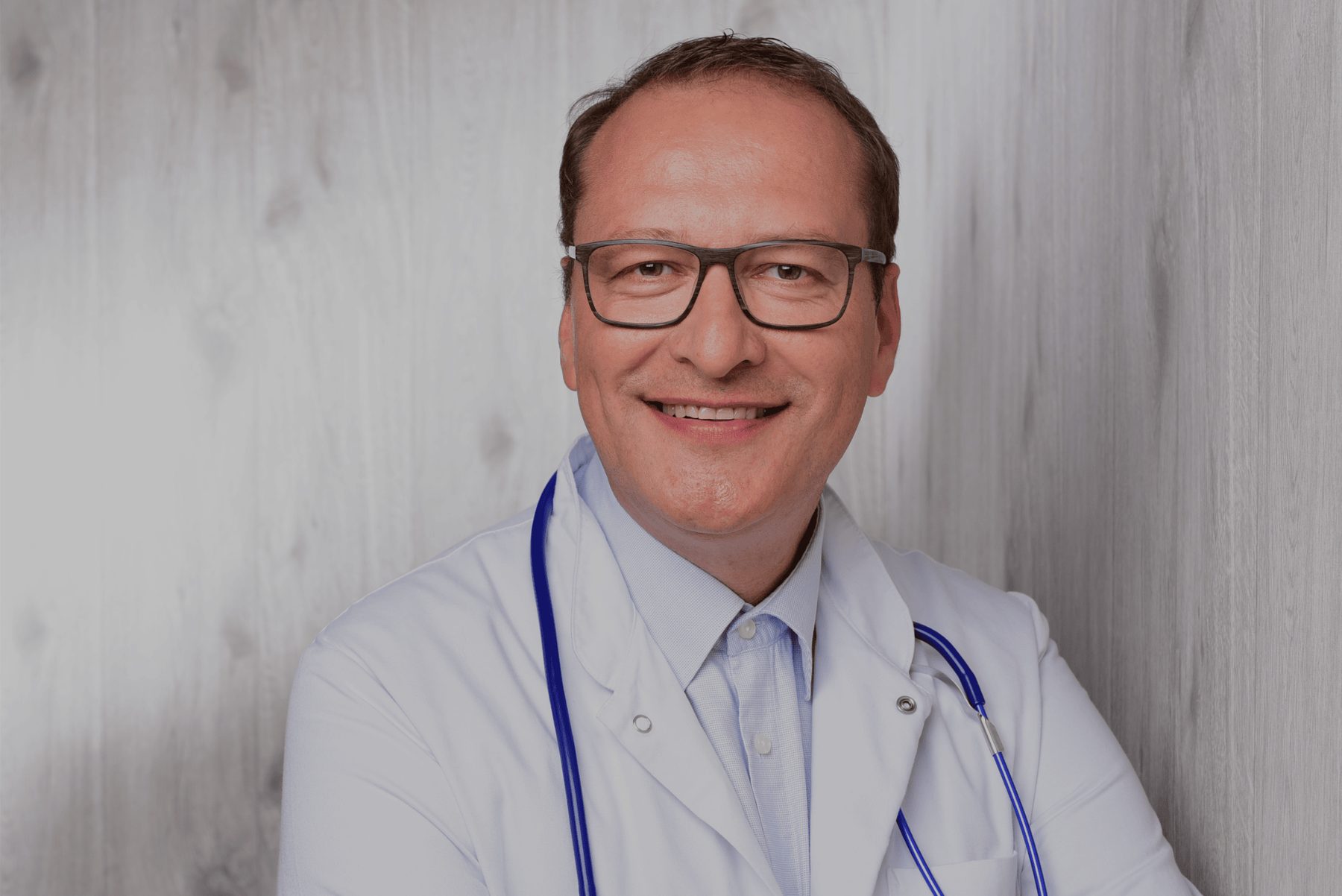
Dr. med. Johannes Link
Specialist in general surgery and vascular surgery · Senior Consultant, Vascular & Endovascular Surgery · Head of the outpatient wound clinic, Diakonie-Klinikum Stuttgart
This text is based on the personal written answers of Dr. med. Johannes Link (August 2026), lightly edited for publication.
This page is general information, not personalised medical advice. It does not replace an examination, diagnosis or treatment by a doctor.